

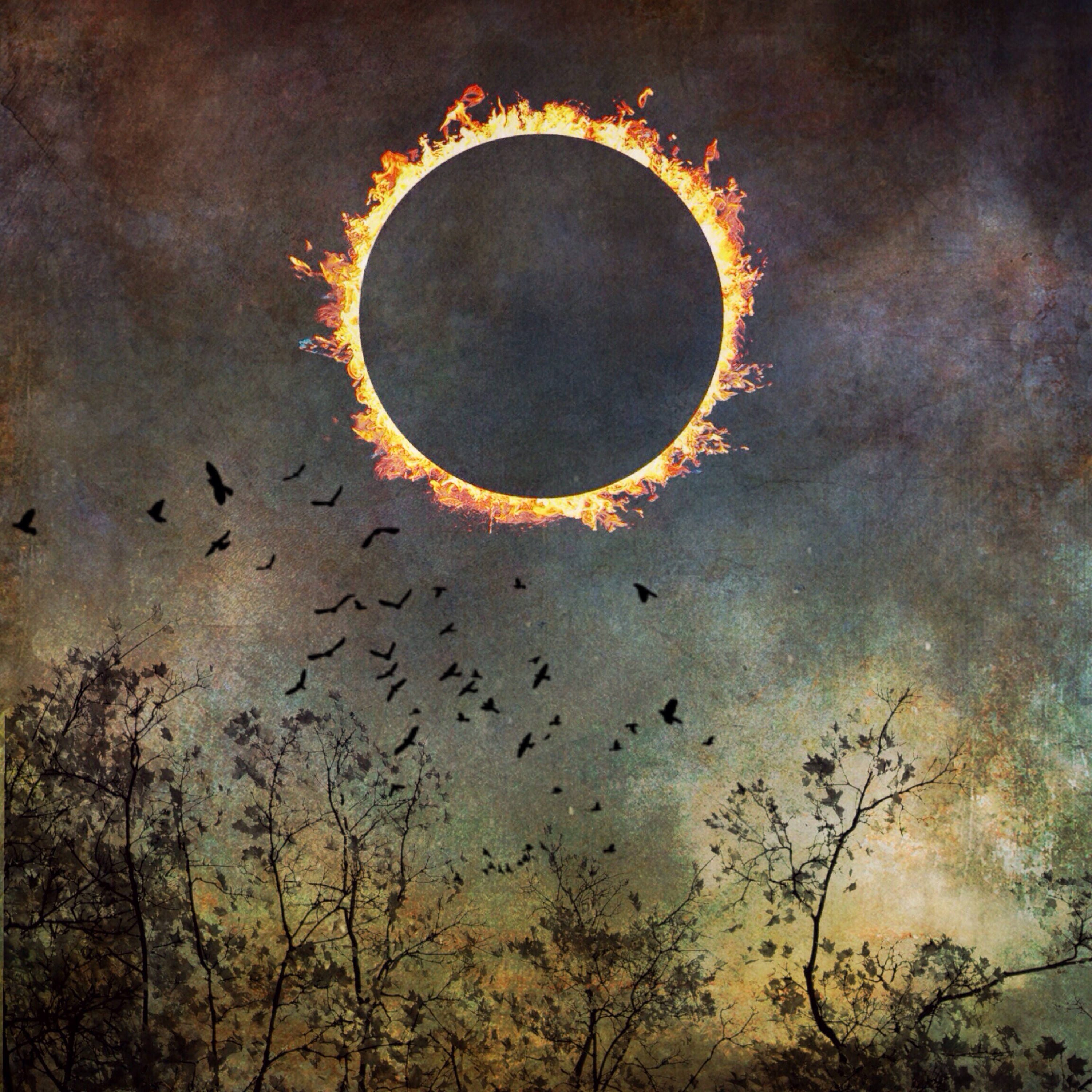
In addition to the video, here are some ‘off-the-top’ of my head facts about eclipses, as the history of eclipses traces a relationship between humanity and the rhythms of the heavens. For thousands of years, the disappearance of the Sun or the darkening of the Moon has been observed, recorded, calculated and woven into the cultural memory of civilisations. Eclipses provided some of the earliest occasions upon which human beings recognised that celestial events possessed recurring patterns, and those patterns gradually became part of astronomy, chronology, mythology and science.
One of the earliest surviving written records of a solar eclipse comes from Ugarit, in modern Syria, where a clay tablet describes the Sun being obscured and refers to Mars being visible during the event. The eclipse is now generally identified as occurring on 5 March 1223 BCE. Ancient Chinese astronomical traditions contain similarly early observations. A record traditionally associated with 5 June 1302 BCE describes the Sun being consumed by what has been translated as three flames, with stars becoming visible. During totality, the solar disc disappears behind the Moon, the surrounding sky darkens, the solar corona emerges and stars and planets can appear within the altered heavens.
The development of mathematical astronomy gradually transformed the relationship between observation and prediction. Edmond Halley, using Newtonian gravitational theory, calculated the path of the solar eclipse of 3 May 1715 and published a map showing where totality would pass across Britain. He also invited observers to record their circumstances and observations. The eclipse was seen as an opportunity to compare mathematical prediction with what could actually be seen from Earth, an approach that has become fundamental to modern astronomy.
The solar eclipse of 18 August 1868 brought another development. Spectroscopic observations during totality revealed an unfamiliar yellow spectral line in the Sun’s atmosphere. The line belonged to an element that had not yet been identified on Earth. It was named helium, after Helios, the Greek personification of the Sun.
During totality of the eclipse of 29 May 1919, astronomers at Príncipe and Sobral in Brazil photographed stars close to the darkened solar disc. Their measurements were used to investigate the apparent displacement of starlight passing close to the Sun, a prediction arising from Einstein’s general theory of relativity. The results were announced later that year and helped establish Einstein as a figure of international prominence. Subsequent observations have provided extensive confirmation of the gravitational deflection of light predicted by general relativity.
Behind these individual events lies an even older astronomical rhythm: the Saros cycle. Eclipses recur in families because several lunar cycles approach remarkably close numerical relationships. A Saros consists of approximately 223 synodic months, 239 anomalistic months and 242 draconic months, periods whose lengths converge sufficiently closely for a similar eclipse geometry to return after approximately 18 years, 11 days and 8 hours. Each recurrence shifts the geographical path, allowing an eclipse family to travel across the Earth over many generations.
The eclipse of 12 August 2026 belongs to Saros Series 126, and is member 48 of a sequence of 72 solar eclipses. Saros 126 began on 10 March 1179 and will conclude on 3 May 2459, giving the series a span of roughly 1,280 years. The 2026 eclipse therefore occupies the forty-eighth position within a celestial sequence that stretches from the twelfth century into the twenty-fifth.
Finally, the Sun is approximately 400 times wider than the Moon, while it is also approximately 400 times farther from Earth. Their apparent diameters consequently appear remarkably similar from our planet. This allows the Moon, despite being vastly smaller than the Sun, to cover the solar disc almost exactly. The Moon’s elliptical orbit produces variations in its apparent size, giving rise to total, annular and partial eclipses. During the 12 August 2026 eclipse, the Moon appears approximately 3.1 per cent wider than the Sun, allowing totality to occur.
I hope that is of interest to you, as the video discusses the psycho-spiritual components of a eclipse.
A


