
Everytime
Ceres, Grief and the Spirit Child

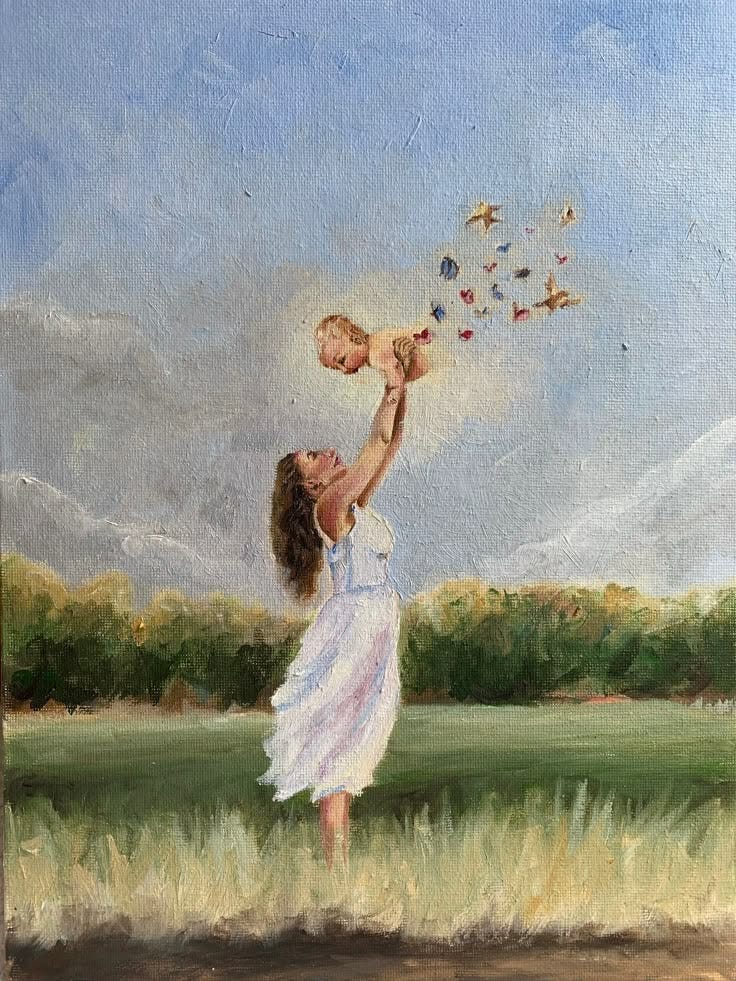
Art by McKayla Lee
There are songs that carry two stories at once, the one dressed and visible on the surface, and the one breathing quietly beneath it, waiting for whoever carries the right key of experience to unlock it. Britney Spears’s Everytime has always seemed, to the casual ear, to be about the end of love between two people. And it is that. But it is also something deeper and darker than that.
Like most people, I first heard it the way, as a hauntingly poignant lament about a relationship broken by one’s own hand and about the sorrow of having damaged something through carelessness or pride. Over time as I became increasingly familiar with Ceres, I heard her Sun-Ceres octile, and the song opened differently, the way a door opens when you finally have the right key, revealing a room you had been standing beside for years without knowing it was there.
The song is about a child. About the particular grief of a parent who has lost a child they never held. And it carries that grief with such fidelity to the interior experience of it that those who know the terrain from the inside will feel recognised in a way that very little else in the culture offers them.
What She Is Singing About
Composed in the immediate aftermath of her separation from Justin Timberlake, his public response yielded Cry Me A River, hers was this song. The difference between the two pieces tells you everything about the difference between accusation and grief. His is lit from outside. Hers descends inward, into water, into something that cannot be resolved by the assignment of blame.
During the span of their relationship, Spears and Timberlake are believed to have faced an unplanned pregnancy, and the decision was made, under whatever pressures attended it, to bring that pregnancy to an end. This is offered here with care and with the full understanding that it belongs to her private life, and shared only because it illuminates, with a clarity that nothing else can quite supply, why this song sounds the way it sounds. Why it feels, in the body of the listener who carries a similar loss, as though someone finally said it.
She sings of seeing a face in her dreams, a face that haunts her, returning again and again without her bidding. She sings of making believe that someone is present, because it is the only way she can see clearly. She sings of having made it rain, of weakness causing pain, of a night-time prayer that the face will eventually fade. And to those who carry the particular grief of a child they never held, each of these images lands with a precision that no surface reading of the song can account for. You are in an ordinary place, doing an ordinary thing, and a child of approximately the right age moves through your field of vision, and for a moment your whole system responds as though to something it has been waiting for. The face assembles itself from fragments you carry without knowing you carry them. You make believe. The wondering moves through you and then settles again, like a bird returning to the branch it had briefly left.
The wondering is the central act of this grief. It circles because it has no facts on which to land, living entirely in the subjunctive, in the continuous and unanswerable question of who that soul would have been. And the melody of Everytime is built in exactly that shape, circling, returning, finding no resolution because resolution is precisely what this grief cannot offer.
Ceres
Ceres, known also as De-meter, the name holding within it the Greek word for mother, has been understood for centuries primarily as the goddess of grain and seasons, the mythological explanation for why the earth turns cold and then warm again. But this is the outermost garment of her story, and what it covers is something far more intimate.
Her daughter, Proserpina, was given by Jupiter to his brother Pluto, consigned to the invisible world, the realm below the surface of the living. Jupiter did this knowingly. He made this arrangement between men, as a business of men, and he told Ceres nothing of it. She discovered the absence herself, in the ordinary way that parents discover absence, by reaching and finding the space where the child had been.
What she did then has been called hysteria, self-indulgence, the destructive excess of the feminine temperament. The earth entered perpetual winter because she withdrew from her work as its nourisher. But spend any time with grief of this magnitude and the myth reads very differently. The person who has lost a child in the irreversible way, through whatever avenue that loss arrived, frequently discovers that the ordinary appetite for life, its colour and warmth and savour, has simply withdrawn. The earth of the interior enters winter. And winter, for some, is very long.
Jupiter knew where Proserpina was. He had arranged it. He had conspired with Gaia and Hekate, and he said nothing to Ceres while she searched. There is something in that detail, the foreknowledge of the one with power, the exclusion of the mother from the decision that concerned her most, that resonates with a painful accuracy alongside the circumstances in which decisions about pregnancy have too often historically been made. The myth has been enacting this for more than two thousand years, waiting patiently for those with the experience to read it clearly.
Grief
There is a category of grief that the world has not yet found the full willingness to acknowledge. It belongs to parents who have lost a child before they had the experience of holding that child, of knowing them in the ordinary physical way. It is the grief of miscarriage and of stillbirth. And it is the grief, the most silenced and most shamed of the three, of those who made the decision to end a pregnancy, in whatever circumstances and under whatever weight that decision arrived.
Each of these losses is distinct and deserves to be understood in its own terms. The parent who miscarried at fourteen weeks has already spent months in interior relationship with a future that the loss suddenly forecloses. The parent who attended a stillbirth has held birth and death in the same room, in the same hour, and carried home arms that expected to be full. And the parent who chose to end a pregnancy, or who found themselves in circumstances where the choosing felt like the only option available, carries a grief further complicated by the question of agency, by the particular torment of having made a decision when no good choice was available, and of living with that decision in a world that offers almost no space for its honest expression.
What all three share is silence.
There are no public ceremonies for these losses. The bereaved parent is expected, by the quiet pressure of social convention, to absorb the grief privately and return to the surface of life without disturbing it. In Ireland in particular, this expectation has been enforced for generations with a thoroughness that has caused a great deal of unnecessary suffering, layered on top of suffering that was already difficult enough to carry alone.
I remember being present in a hospital ward while a miscarriage was in progress. What struck me, with a force that I have carried since, was the sheer ordinariness of the ward. The quiet faces of the women there. The practised steadiness of the nurses. The absence of ceremony around what was, in each of those beds, a private devastation of the first order. What struck me further was learning how common miscarriage is, how significant a proportion of pregnancies end this way, and yet how completely the culture had decided that this fact should remain, as much as possible, unspoken. The women had arrived largely alone. They would depart without the wider circle of those who loved them having been made aware of what had taken place. The grief had been rendered, by a hundred small and unexamined social decisions, effectively unspeakable.
That is the Cerian winter. Enacted in fluorescent light and institutional quiet, in a country that had decided, long before those women arrived, that this particular grief was one to be absorbed in private and released into silence.
The Spirit Child
In the spiritual traditions that have retained their understanding of the soul as primary, as something that precedes and exceeds the physical body rather than being produced by it, there is a concept that many cultures have carried in their own particular language: the spirit child. It is the understanding that a soul which comes close to incarnation, which enters into relationship with its potential parents, does not simply cease when the physical body through which it might have been known is surrendered before completion. The soul continues. It belongs, in some sense, to the constellation of that family’s spiritual life. It remains in relationship.
I offer this as description rather than doctrine. It is a description of what many parents who have lost children in these ways actually experience, and experience with a consistency and an intimacy that invites serious attention rather than dismissal. The parent who has lost a child to miscarriage, to stillbirth, or to an abortion entered into under circumstances of great difficulty, frequently reports a sense of ongoing interior relationship with that soul. The wondering about who they would have been. The noticing of children of approximately the right age, moving through the world with the particular quality of attention that carries a trace of something familiar. The love that continues, not because one has decided to sustain it, but because it simply does, the way love tends to when it has had nowhere to land and nowhere to leave.
In Blue Rose School of Astrology, in the years of teaching between 2018 and 2023, students brought their own stories when I first broached this side of her holon. Stories of miscarriage and of decisions made in difficult circumstances, of grief carried privately for years before finding a room in which it could be spoken, abounded. What this side of the Cerian archetype offered to those students, and what I have seen it offer again and again, is a framework that treats these losses as real, the love as real, the child as real in the full spiritual sense, and the grief as something that deserves acknowledgement rather than management.
The heuresis, that concept from the Eleusinian mysteries of discovery arising from descent, the treasure found within the grief rather than in spite of it, is what the Cerian path offers to those willing to go all the way down into it. The spirit child, understood in this way, is a teacher. The teaching arrived by a route one would never have chosen. And yet what it has opened, in those who were willing to receive it, tends to be among the most significant openings of their interior life.
What the Father Carries
This grief has been spoken about primarily as a grief belonging to a mother who carries the unborn or stillborn. And it belongs to them fully and first. And it belongs, in its own form and with its own particular shape, to fathers as well.
I recall standing at the end of a street, in the cold exposure of a public telephone box, in my early twenties, talking with someone I loved about a decision whose weight was entirely beyond the resources either of us had been given for carrying it. I recall the smallness I felt. The inadequacy of everything I said and everything I could offer across that distance. And I recall the silence that grew around the experience in the years that followed, a silence that was built from shame and from the complete absence of any language or any companionship in which it could have been named.
She had to take care of it alone. That is something I have returned to many times - the particular damage of that distance, of the circumstances that made presence impossible, and of my own failure to find a way through them. I was young, and perhaps it is an excuse for some of what I could not manage. Yet it does not fully account for it either. What I know now, that I did not know then, is that I was grieving too, in the formless and unacknowledged way that grief inhabits a person when there is no word for it and no place to put it.
The shame of that time had an adhesive quality. It stayed. And layered into it, when I finally found my way into a space where any of it could be looked at honestly, was something I had not expected: love. A love for the soul that had come so close and continued its journey elsewhere. A love that had no ceremony, no public name, no shared witnessing with anyone who had also known that child, however briefly and in whatever form. A love that existed within, without validation, and is no less real for that.
Some years later, in the second trimester of another pregnancy, with another partner, a child was lost to miscarriage. I was present in the hospital that time. And the two griefs were entirely different in texture and yet recognisably of the same family. Both of them formed me in ways I am still discovering. Both of them are present in what I bring to this teaching. Both of them are part of the reason the Cerian archetype has always felt, to me, less like an astrological concept and more like something that knows me personally.
The Return
The mythology of Ceres does not end in winter, and this is the heart of what she offers. The grief she enacts is real, it is devastating, and it is also a passage. There is a negotiation. There is a partial return. Proserpina ascends, and the earth blossoms with the force of the reunion, and yet Proserpina also carries within her the pomegranate seeds that will draw her back each year, and Ceres has learned to live within that rhythm, the blossoming and the loss, the fullness of summer and the long retreat of winter, as an ongoing relationship with what cannot be fully resolved.
This is what healing tends to look like, in my experience of it and in my witnessing of it in others. The grief does not disappear. It finds a rhythm. There are seasons of acute loss, and there are seasons when the love that has nowhere to land finds a way to become generative, to flow outward into tenderness for others, into creative work, into the particular quality of presence that those who have been in this darkness tend to bring to anyone else they find there.
The heuresis of the descent is this: the spirit child is a teacher. The love one carried for a soul that did not complete its journey into the ordinary world is a love that has shaped one, deepened one, widened one’s capacity for compassion in ways that nothing else quite accomplishes. The spirit child gives something. The giving arrives wrapped in grief, and yet the gift is real.
This is what I hear in Everytime, beneath the surface of the love song it appears to be. A parent singing to a child who is elsewhere. In the only language available to her. Hoping, in the way parents tend to hope for things they cannot verify or control, that somewhere in the invisible country where all souls rest between their incarnations, the child hears. And knows they are loved. And knows they were always loved, from the very first moment, even when the circumstances made that love impossible to speak aloud.
To Those Who Carry This in Silence
In any room of people gathered around the kind of work we do in Blue Rose, there are more of these griefs present than are visible. The woman who sits quietly near the window carries the memory of a child lost at twelve weeks, a loss she has told almost no one about. The man who speaks with ease about the children he has raised has held in private, for twenty years, the knowledge of one who came before them and continued elsewhere. The person who has lived without children, and who deflects with a lightness that has taken years to perfect the questions that attend that fact, carries an experience that has found almost no room in the world.
These griefs are ordinary in their frequency. They are extraordinary in their depth. And they are served very poorly by a culture that has decided, largely without discussion, that they do not quite qualify as losses in the full sense, that the love invested in a child who did not arrive, or who arrived and did not remain, is something less than the love one has for a child one has held and known and raised.
It is love of the same order. It creates a parent in the fullest sense. And it deserves the same quality of witnessing and acknowledgement as any other form of grief that the heart carries.
To those who carry this: you are parents. The child you lost is real. The love is real. The soul that came close to you and shaped you and then continued its journey is real. You are allowed to love what you lost. You are allowed to mourn it, at whatever pace and in whatever form the mourning requires. You are allowed to speak of it, in whatever company feels safe enough to hold it. And you are allowed to understand the spirit child as a teacher, as a presence that has given something to you, even in its passing, even in its brevity, even in the silence that followed.
Ceres teaches that the parent separated from the child remains a parent through the continuing force of the love itself. The love outlasts the winter. Season after season it persists, patient as soil, faithful as the return of light. And in the larger story, the one that holds both this life and all that lies beyond it, the reunion that Ceres searched for and finally, partially, found, is the reunion that all such love is quietly and steadily moving toward.
Until then, the song continues.
Everytime.
Thank u for acknowledging the hidden pain in all of us for past decisions… the haunting, the questioning, and hopefully one day the acceptance that we made the best and perhaps the only decision that we could at the time ❤️
Thank you Andrew for this poignant and beautiful sharing and reflection. It puts words to my experience of the ebbing and flowing process of deep grief and love I share for a spirit grandchild. Memories surface of some very painful, difficult times and circumstances in our little family and the journey we each have and have been on together, since. Sweet blessings to you. 🙏✨️